Pursued: Ransomed Into Romance (Part 2)
What if the thing that nearly broke you was never punishment?
I did not forget what Christianity is. That would require having truly known it in the first place.
I grew up surrounded by it. Enveloped in it. Christianity was the water I swam in, the air I breathed, the grammar of my entire childhood. I knew the vocabulary. I knew the stories. I knew the arguments well enough to win them. I had the architecture of belief memorized from the outside, every doctrine in its proper place, every answer to every question and objection ready.
What I did not have was the thing itself.
It was not until I pulled out the love letters God had written to me and actually read them, not to win a debate or defend a position, but to find out what they said, that I discovered something that stopped me cold.
Christianity is not what I thought it was.
It is not what most people think it is.
It is something far more scandalous. Something orders of magnitude more enthralling than the version I had been handed before I was old enough to question it. Something so staggering that saying it plainly still feels either delusional or like the truest sentence I have ever spoken.
Christianity is about one thing: intimacy with the God who made me.
As a Person. As a Presence to encounter. God giving Himself to be known. I do not mean known like information. I mean the ancient, dangerous, biblical knowing. The kind that undoes your defenses. The kind that pulls a man out from behind his fig leaves and makes hiding impossible. The kind of knowing that comes from wrestling with God through the long night of the soul, refusing to let go until the blessing comes, walking away with a limp and a new name.
Jesus said: ask, and you will receive. Seek, and you will find. Knock, and the door will be opened. Then He said something that has always undone me:
“If you, being imperfect, know how to give good gifts to your children, how much more will your Father in heaven give good things to those who ask Him?”
— Matthew 7:11
The answer was never hidden. It was written down and handed to me. I just had to open it. I just had to ask.
I did not learn this in a library.
I learned it in the olive press.
✠✠✠
The Press
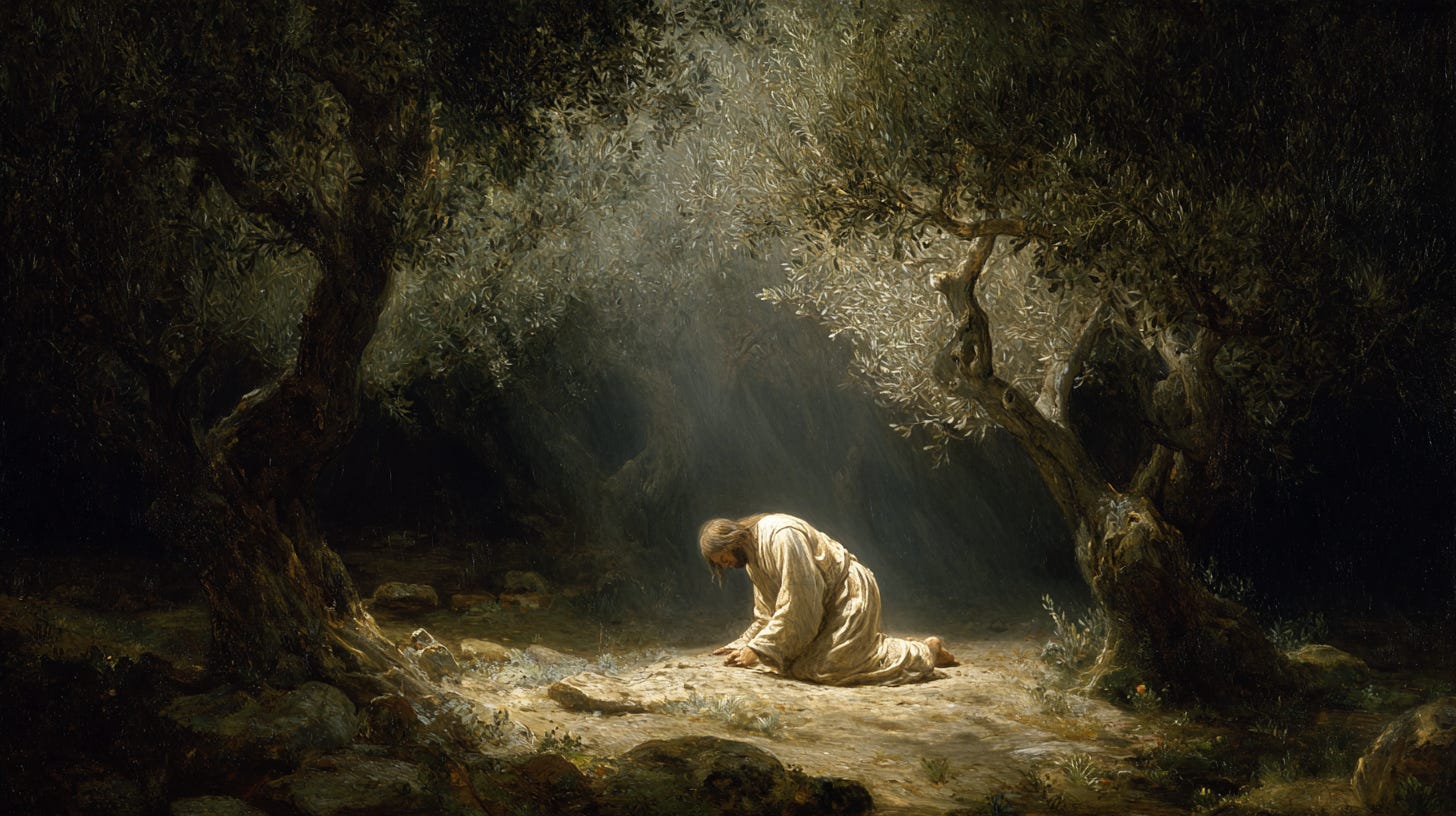
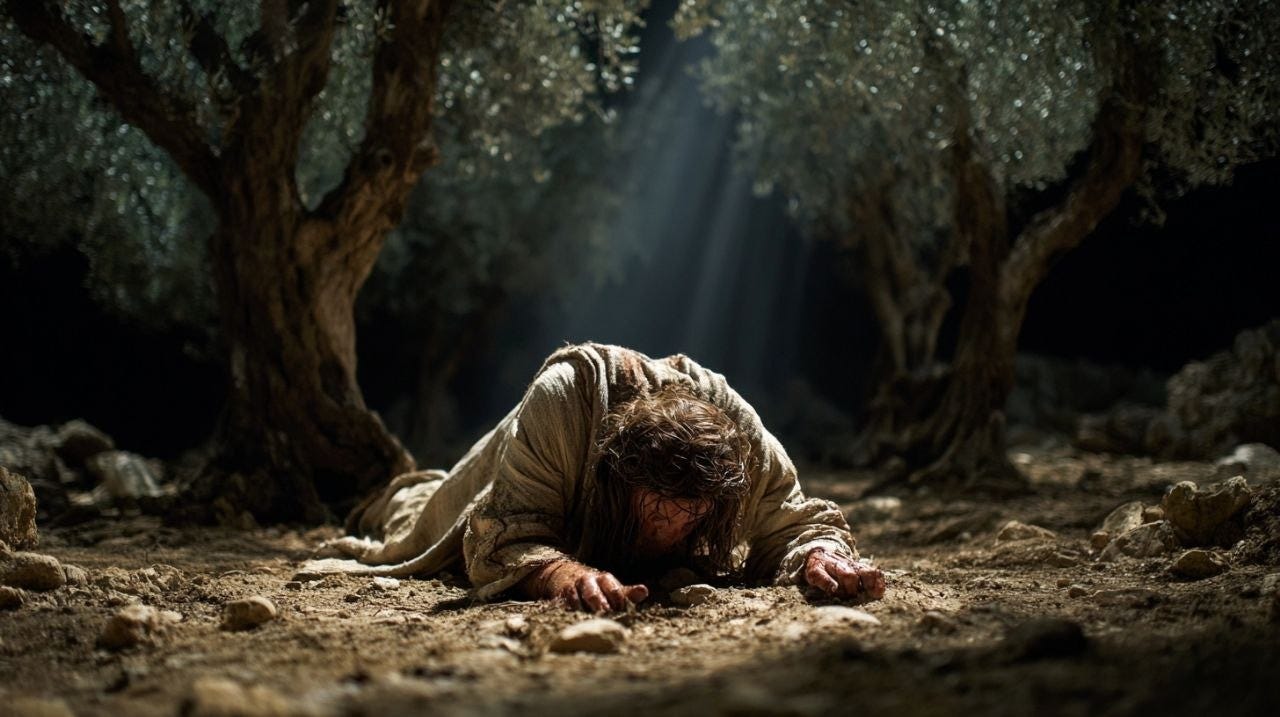
The word Gethsemane, the garden where Jesus sweat blood the night before the Cross, means oil press. The place where the olive is crushed until it yields what is hidden inside. If I have come to know anything, it is this: it is not a metaphor. It is a description of how God does His deepest work in a human soul.
Two days before Brielle, my second daughter, was born, I lost my job. Wholly unexpected. The way I was providing for my family, gone without warning. Then Brielle entered this world through terror. Placental abruption. Emergency. Chaos. I stood there, staring through an incubator at a fragile, perfect body fighting to breathe. Intubated. Fed by tubes. Her life on the edge of a cliff, second by second. A child I would have traded my life for without hesitation, connected to wires I did not understand in a room that smelled of antiseptic and dread.
For a month she lived in a NICU. For a month I lived on my knees.
No philosophy helps in a NICU. No argument steadies a father watching machines do what his own hands cannot. In that room I did not need intellectual triumph. I did not need a well-reasoned theodicy. I needed mercy. I needed God to be near. I needed the kind of Presence that can hold a man together when his illusion of control has burned completely to ash.
He was just that. Not loud or theatrical, but near. The way a father sits beside a sick child through the night without speaking. His presence doing what words cannot.
A year later the press found me in a hospital bed of my own. Emergency room by ambulance. ICU. My heart stopped. Emergency surgery to stay alive. I came home from that hospital to a marriage already fracturing at every seam, and within weeks I no longer lived under the same roof as my children. The separation was official.
What followed over the next years was not a single event but a slow, grinding demolition of everything I had built my sense of self around. The family. The home. The future I thought I was living toward. All of it came apart.
The years that followed were the narrowest of my life. A single father, working whatever flexible job would let me stay present with my daughters rather than hand them to a stranger. Surviving on less than enough in every direction. The kind of years that strip a man down to what he actually believes when there is nothing left to perform for.
I will not assign blame here. The press does not require a villain. It only requires weight, and there was weight enough to last a lifetime.
What that season did to me, I did not fully understand until years later. It did not merely break my heart. It reconfigured something in my nervous system. It convinced me, at a level deeper than conscious thought, that intimacy and closeness with another human was perilous. That love was the name of the wound. That openness was the mistake. That the only safe heart was the closed one.
That to love again was to risk annihilation.
I built walls. Not metaphorical ones. Fortress upon fortress. Concentric circles of concrete and steel and razor wire, each one built beyond the ruins of the last. These structures did not feel like choices. They felt permanent. Immortal scars that could never be healed back to unwounded flesh. I was convinced, with the serene certainty of a man who has learned something the hard way, that they would stand forever.
2020 brought a different kind of press. The entire edifice of my theological framework, the one I had built my identity on as a sincere, devout, believing Mormon for the whole of my life, came down. Because I loved truth more than I loved the institution. The deeper I pursued God with genuine sincerity, the larger He became. What I discovered was that the Jesus of Mormonism had become too small to contain the God I was actually encountering.
I want to be straightforward with you. Some will hear that and think: apostasy. I understand the instinct. However, I did not leave God. I left a container that had become too small to hold the God I was actually finding. That is not apostasy. That is the story of nearly every serious Christian mystic and seeker throughout history. The willingness to let go of a smaller thing in pursuit of a truer one. My faith did not shrink when I left. It expanded. I pursued God more honestly, not less.
I know what the default assumptions are when someone leaves. That is not my story. I left from the inside of sincere belief, not from the outside of it.
Which meant that by 2020 the theological ground and the relational ground had both shifted beneath me, and the question that remained was not one I could answer from a library. It was rawer than theology. It lived in the body, in the chest, in the particular exhaustion of a man who has been through what I had been through and still, somehow, has kept his heart open.
Is any of this worth staying open for?
It is.
But I did not find that cheaply.
Then something happened in a winter cabin that I still do not have full words for.
Stillness. In the stillness, a Presence.
I will not dress it up into something more impressive than it was. No thunder. No blinding light. But something entered the room, or perhaps I became aware of what had always been there, and it was not soft. It was the kind of strength that does not need to raise its voice. A Lion, fierce and sovereign, yet unthreatening. Authority without intimidation. Power that did not reach for your throat but for your hand.
What this Presence did not do was spare me from further suffering. What it did was far harder and far better.
It began to open what I had permanently sealed. That was the miracle.
Let me be precise about what made that miraculous. Not the visitation itself. What was miraculous was the out-working. Because a heart that has been through what mine had been through does not simply reopen. Every natural law of the human soul says it stays closed. The scar tissue alone should have been enough. Yet over the months and years that followed, something began to happen inside me that I knew with absolute certainty was beyond my own capacity. God had worked a mighty wonder. Truly. He had taken my heart of stone and given me back a heart of flesh. Walls came down. Not all at once. Not without resistance. But they came down.
I began to trust again. To hope again. To love again, without reservation, without keeping one hand on the exit. I experienced beauty and connection with someone I had risked giving myself to again in a way I never thought possible.
Which is precisely why what came next cut so deep.
It ended through a text message. More than six years of shared life, dissolved in a sentence on a screen.
The kind of ending that does not just hurt. It feels like death, except the body is still living. It reaches back through everything and retroactively makes you doubt what was real.
The thing that made it devastating was not just the loss. It was that the heart being broken was the one God had spent years miraculously rebuilding. The heart that should have been permanently sealed. The one that had no natural business being open again in the first place. A heart that began to dream with child-like wonder and hope again.
If you have ever watched something you knew was a miracle get broken, you understand the particular quality of that grief.
I am writing this from inside the aftermath, sometimes asking whether the miracle was real, and still choosing to believe it was. Which is perhaps why I can say with more conviction than I could have said otherwise:
The press is not punishment.
It is the place where the oil comes from.
What carves itself deepest into our bones can, by grace, become our greatest offering.
✠✠✠
The Oil and the Lamps
Gethsemane.
Most of us know it as the garden where Jesus sweat blood. The place of anguish. The place where He prayed not my will but Yours and the disciples fell asleep.
But Gethsemane is a Hebrew word. Gat shemanim. Oil press.
The olive, one of the most ancient fruits in the world, does not yield its oil willingly. It must be crushed. Pressed under unimaginable weight, until what was always hidden inside is finally released. The oil does not come from the outside. It was always there, sealed within the flesh of the fruit. The press does not create it.
The press reveals it.
Jesus chose to pray the night before His death in a garden named for the crushing. He did not stumble into Gethsemane. He walked there. Deliberately. Knowing what it meant. Knowing what was coming. In that press, the full weight of human sin, the abandonment of His closest friends, betrayal that came with an intimate kiss, the horror of what awaited at dawn, He yielded. Willingly. For love.
What flowed from that crushing lit the world.
Now consider the parable He told.
“At that time the kingdom of heaven will be like ten virgins who took their lamps and went out to meet the bridegroom. Five of them were foolish and five were wise. The foolish ones took their lamps but did not take any oil with them. The wise ones, however, took oil in jars along with their lamps.”
— Matthew 25:1–4
The detail that most of us read past, the detail that carries the whole weight of the story, is the oil.
The wise virgins had it. The foolish ones had none.
Notice what they did have. Lamps. They came with lamps, which means they came with the outward form of readiness. They knew the bridegroom was coming. They showed up. They were, by every visible measure, part of the wedding party.
What they had not done was obtain what only comes from the press.
“The bridegroom was a long time in coming, and they all became drowsy and fell asleep.”
— Matthew 25:5
It was not until midnight, the hour every Jewish listener knew, when God had always chosen to act. Not the darkest hour, but the most suspended one. The exact midpoint between the last light and the first. The hour of maximum uncertainty, when you cannot see what is behind you and cannot yet see what is coming. That is when the cry went out: “Here is the bridegroom! Come out to meet him!”
The bridegroom was not running behind. Midnight was always the hour.
The darkness was the season the oil was for. The lamps and the light-generating oil were never meant for daylight. The wise ones had understood this. The foolish ones had assumed that lamps were enough, that showing up was enough, that the outward form of readiness was the same as the interior reality of it.
It was not.
Where did the oil for those lamps come from? From a press. The oil of gat shemanim. The oil released only under the crushing. The oil that cannot be summoned at the last second, stored up by good intentions, or borrowed from another soul.
The wise virgins were not being selfish or stingy when they firmly said no, when asked to give some of their oil.
What the press produces in you belongs to you alone. The intimacy God forges in the crushing cannot be transferred, outsourced, or performed. No one can be close to God on your behalf. Intimacy by its very nature cannot be proxy. It must be received in the dark, under the weight, in the garden named for exactly this.
This is not a contradiction of the gospel. The oil of Gethsemane, what flowed from Christ’s own crushing, is offered to every soul without exception. It costs you nothing to receive because it cost Him everything to produce. That offer is as open as the arms He spread on Calvary.
The wise virgins had oil because they knew the lamp was never the point. The oil was.
When the cry rang out at midnight, the foolish ones discovered what religion without encounter always produces: The lamp is not the light. The lamp is only ever the vessel. A vessel with no oil is a beautiful, empty thing. No divine life in it, no substance capable of producing illumination, nothing that can push back the dark.
The lamp was always meant to be the vessel. The oil was always meant to be His presence within it.
Jesus told His followers: you are the light of the world. Not you have light. You are it. Each lamp a fractal of the Source, each flame drawing from the same oil pressed in the same garden, each one commissioned to carry into the dark around them something of the Light that entered the world and refused to be extinguished. But only if the oil is there. Only if the press has done its work.
The lamp without oil cannot fulfill the one purpose it was made for.
In the same parable, they came saying, “Lord, Lord, open the door for us!” Jesus said something that must have stopped everyone in the room: “Truly I tell you, I do not know you.”
The same words from Matthew 7. Spoken twice. The natural consequence of arriving with the form of devotion and none of its substance. With the lamp and none of the oil.
The foolish virgins were not evil. That is the most unsettling thing about them. They were simply unintentional. They knew the bridegroom was coming and treated that knowledge casually, as though knowing were the same as being ready. As though the lamp were the same as the light.
This is the mistake of the age. Not outright rejection of God, but the slow, comfortable, even mindless business, of fitting a little of Him into a life organized around everything else. A Sunday service here. A prayer in crisis there. The lamp carried out of habit, the oil never sought.
The invitation of the parable is not complicated. It is not to more religious activity. It is to re-orientation. To stop trying to fit God into your life and begin building your life around Him.
The invitation is this: to make union with the Lover of your soul the very epi-center of your life. To make that divine relationship the source from which everything else flows and to which every other plan yields.
The oil is His presence within you. The lamp is everything you bring to the world. One without the other is just something beautiful to carry.
What is being pressed out of you, right now, is oil.
The Bridegroom is coming, and it is not yet midnight.
✠✠✠
Your Press
I do not know what your press looks like. I only know it has a name.
It may be a hospital room. A marriage that went silent before it ended. A faith that once felt alive and now feels like going through the motions in an empty building. It may be the 2am sleeplessness when the performance has finally run out and something underneath it is asking, quietly but insistently, to be found.
It may be the wound you have never named to another living soul, the one so deep you have started to wonder if it is simply who you are.
For the reader who hears that and feels the fear underneath it: what if I don’t have enough? The oil is not your accomplishment. It is not something you manufacture through sufficient devotion. The press belongs to the Gardener. He tends it. He sets the weight. He promises that what is pressed out of you in His hands will be exactly what is needed for the lamp He has prepared for you to carry.
This is not about your performance. It never was. It is about your willingness to yield, as He did.
“Not my will, but yours.”
His presence is not withheld. It flows the way sap flows from vine to branch, not by striving, not by earning, but by remaining in the vine.
Whatever it is, the press is doing something, and what it is doing cannot be accomplished any other way.
What carves itself deepest into our bones can, by grace, become our greatest offering.
The oil was always there. The press only reveals it.
✠✠✠
This Is Not Punishment
There is a question so old it has calcified into instinct.
When the press comes down, when the thing you most feared finally happens, the question rises before you can stop it. You may not say it out loud, but somewhere underneath the theology, underneath the composure, it is there:
“Who is to blame?”
Maybe you blame yourself. If only I had done this differently. If only I had been stronger, wiser, more faithful. If only I had seen it coming.
Maybe you blame your parents. The wounds they carried that became wounds they handed down. The silence that shaped you. The absence that defined you. The theology they gave you before you were old enough to question it.
Maybe you blame the one who hurt you.
Maybe you blame God, and maybe you have never said that out loud either.
This reflex is not new. It may be the oldest theological instinct in the human story.
Job knew it firsthand.
Job was, by every account, a righteous man. Scripture itself says so. Yet catastrophe arrived on his doorstep without warning or reason. His children died. His wealth was gone. His health collapsed. Then his friends came.
They sat with him in silence for seven days, which is the last time they were helpful. Then they opened their mouths, and what they said, in various sophisticated ways, was this: you must have done something to deserve this. A good God rewards the righteous and punishes the wicked. Therefore your suffering is evidence of guilt.
It sounded like theology. It was a lie.
God Himself called it a lie. At the end of the book, He turned to those friends and said plainly: you have not spoken of Me what is right. Their theology of retribution, their clipboard God tallying the ledger of human behavior, was a distortion of who He actually is.
Job, who had argued with God, wept before God, demanded answers from God, and refused to pretend the suffering was his fault? God called him My servant, and gave him back everything.
The reflex to assign blame to suffering is ancient and universal, and it is wrong.
The disciples standing in front of a man born blind asked the same question. They dressed it in religious language, but the human reflex underneath was identical:
“Rabbi, who sinned, this man or his parents, that he was born blind?”
— John 9:2
Someone must be responsible. The clipboard God demands an explanation for every suffering, and the human heart, trained by that false god, searches frantically for the name to put on the ledger.
Jesus dismantled thousands of years of human instinct in a single sentence.
“Neither this man nor his parents sinned. This happened so that the works of God might be displayed in him.”
— John 9:3
Neither.
Stop blaming your parents. Stop blaming yourself. Stop searching the ledger for the line that explains why the press came down how and when it did.
When you are tempted to think that two thousand years of human progress have moved us past that question, look honestly at your own interior life the next time suffering arrives. The reflex is still there. It has simply learned to whisper instead of shout.
What did I do to deserve this?
Is this because of what they did to me?
If only...
Joseph knows something about this.
His brothers conspired to murder him. Thought better of it and sold him into slavery instead. Human trafficked by his own family into an ancient world where brutality we barely have the vocabulary for was commonplace. He spent years in a foreign land, falsely accused, unjustly imprisoned, forgotten. If anyone had the right to spend their life searching for someone to blame, it was Joseph. His suffering had actual names attached to it.
Yet when the moment of reckoning came, when his brothers stood before him trembling, Joseph said something that has echoed like a clarion call down through four thousand years of human history:
“You intended it for evil. God intended it for good.”
— Genesis 50:20
He did not minimize what they did. He did not pretend the years in the prison were painless. He simply told the truth about what he had come to understand in the press: the crushing was not the final word.
Paul knew something about the press as well. Before his conversion he had stood watching followers of Jesus be executed, holding the coats of the men who threw the stones. After his encounter with the risen Christ, he was shipwrecked three times, beaten with rods, flogged within an inch of his life, imprisoned in chains, stoned and left for dead. He was not writing Romans 8 from a comfortable chair. He wrote it from inside a prison cell. From inside the crushing.
“And we know that all things work together for good to them that love God.”
— Romans 8:28
Not some things. Not the easy things. Not the things that make theological sense from a comfortable distance.
All things.
The NICU. The ICU. The marriage that came apart. The betrayal that arrived with an intimate kiss. The text message that ended years without the dignity of a conversation. The silence of a father. The wound so deep you have started to wonder if it is simply who you are.
All things.
This is not a promise that none of it will hurt. It already has. This is a promise about what the Gardener is doing with the crushing.
What God takes you through is far more an indication of what He intends to do through you than it is a measure of your worth, or adequacy.
The blindness was not a verdict. It was a canvas.
The Anointed One knelt in the dirt, made mud with His own hands, and pressed it into the man’s eyes.
Go and wash, He said. The man went, and he came back seeing.
The hands that shaped Adam from the ground shaped clay from the same earth and touched eyes that had never seen light. The first time those hands worked with dust, they made a man. This time they restored one. The Cosmic Potter has not changed His methods. Only His material.
Dear Reader, the same hands are available to you. Will you let Him kneel in the dirt of your life and restore what you have never been able to see?
Stop blaming. Stop searching the ledger for who is responsible for your press. The question the disciples asked has already been answered. It was answered in a garden named for crushing, by The One who chose it willingly, who took the full weight of every evil ever intended against you, and declared:
God intends it for good.
The canvas is not finished.
The Anointed One is already kneeling in the dirt.
✠✠✠
Name It
There is a practice I have come back to again and again in the years since the cabin. A simple and terrifying one.
We have made confession into something it was never meant to be. A criminal admission behind closed doors. A reckoning before priestly authority. A transaction that leaves you feeling managed rather than loved.
That is performance wearing the costume of confession. True confession is something far older and far more intimate. It is truth-telling before the One who already knows. It is Adam hearing the voice in the garden calling Where are you? and finally answering honestly instead of hiding deeper in the leaves. Do you really think God didn’t know where Adam was? That question was a summons back to intimacy.
God was not asking with the stern voice of a judge about to deliver a sentence. He was asking with the voice of a Father who missed His child. Come close. Tell me what you are carrying, so you can be free.
“If we confess our sins, He is faithful and just to forgive us our sins and to cleanse us from all unrighteousness.”
— 1 John 1:9
“Therefore confess your sins to each other and pray for each other so that you may be healed.”
— James 5:16
“Therefore, there is now no condemnation for those who are in Christ Jesus.”
— Romans 8:1
True confession is the beloved speaking to the Father.
Picture her for a moment. Dragged in. Exposed. Humiliated. Every failure made public before she could compose herself or construct a defense. Thrown at His feet before the crowd, before the accusers, and before the one person whose opinion of her actually mattered.
Without her saying a word, He already knew everything.
He knelt in the dirt beside her and wrote something no one recorded. Then He looked up at the crowd. Then He looked at her.
“Neither do I condemn you.”
His feet. That is where you bring what you cannot carry anymore. The fear. The failure. The thing you have never said out loud to another living soul. You do not have to compose yourself first. You do not have to have the words. You only have to come.
Name your fears to God. Not the sanitized version. Not the acceptable spiritual request. The actual thing. The thing underneath the thing. The lie you did not know you believed. The fear behind all other fears. Name it. Out loud if you can bear it. To the One who already sees it and is still here.
I will go first.
I am afraid that every relationship that ends confirms the lie I have been carrying since before I had words for it: that I am the one thing in the room that cannot be kept.
I am afraid that God sees exactly what the people who left could not stay for.
I am afraid that if I stop performing, there will be nothing left worth loving.
I am afraid that the silence of a father says something permanent about my worth.
I am afraid the wound goes deeper than any healing can reach.
I am afraid I don’t have what it takes, and I’ll never be enough.
I am afraid I have failed my daughters by bringing them into a fractured family.
Name it. Whatever yours is. Because the thing you cannot name has power over you. The thing you name to God loses its grip.
This is not a technique. It is the oldest act of trust in the human story. It is what Adam refused to do when he hid instead of speaking. God was not looking for a geo-location, or information when He called out Where are you? He was inviting Adam to stop hiding and come close. To be known.
That invitation has never been revoked.
Stop hiding. Come close. Name the fear. Let the One who already knows it lavishly love you anyway.
✠✠✠
Why Are You Hiding?
Why do I perform? Why do I curate the version of myself I present to the world, to my family, my co-workers, my friends, and worse, the version I present to God, as if I could hand Him a resumé polished enough to finally be safe?
Everything is already before Him. He is not a cosmic surveillance camera tallying your failures. My friend, He is the One before whom all reality is, as the writer to the Hebrews says, naked and open. He sees. He knows. Every wound you have never named. Every failure you have hidden under competence. Every place where you have told yourself what so many of us were told, in one form or another:
No one is coming to save you. Learn to need no one. Stand on your own.
That sentence has been dressed as wisdom. It has been dressed as strength and independence and maturity. It is none of those things. It is a wound wearing a mask.
Above all it is a lie.
Its author has been speaking it since the first garden.
That lie is one of the most consequential in the modern world. It is meant to isolate, to separate, to convince you, you are alone. Which in turn leaves the door to despair and hopelessness wide open, for the enemy to come in and wreak havoc.
The truth, the story of all of Scripture, from Genesis to Revelation, is precisely the opposite: Someone did come. Someone came from further away than distance has a name for. He crossed eternity. He descended into death itself. He defeated an enemy far greater than any empire, any army, any darkness you are currently standing in front of. He did it not to leave you to fend for yourself afterward, but to be near. To dwell inside the very chest that has been carrying all of this alone.
“This is the secret: Christ in you, the hope of glory.”
— Colossians 1:27
Instead of recoiling He comes closer.
We can make our peace with a God who is theoretical, useful, philosophical. A God kept at the safe distance of doctrine and Sunday attendance. But a God who actually wants you? Who pursues not your compliance but your heart? That is the thing that undoes us. Because it means there is nowhere left to hide.
That is exactly where healing begins.
This is my witness. It is not an argument or a case I am building. It is what I lived: When my heart was shattered again, when intimacy betrayed me again, and I felt like I was bleeding from the inside out, I did not find God standing at a distance with His arms crossed, waiting for me to compose myself. I found Him as a place to weep. A chest to collapse into. A tourniquet for the kind of bleeding that has no visible wound.
Not a theory to master. Not a proposition to defend. A Presence to cling to.
That alone changed what I understood Christianity to be.
The purpose of my life is not to know about God. It is to know Him. To be known by Him. To return to Him with a whole heart and to call others out of hiding.
Lay down the performance. Leave the posturing behind. Come close.
God did not make you to perform your way to heaven. He did not make you to fit in. He made you to belong, to Him. He made you for something ancient and dangerous and alive.
The God who made you is not merely out there, sustaining galaxies with impersonal force. He is near. He is holy. He is Love, and Love, by its nature, cannot remain at a distance from the one it loves.
“Holy, holy, holy is the Lord God Almighty, who was, and is, and is to come.”
— Revelation 4:8
Day and night the throne guardians never stop crying out because they are undone by Him again, and again, and again. Every repetition a fresh rupture of wonder. As if holiness keeps revealing new depth every time they look. Holiness that cannot be exhausted.
I, dust, father, wounded man, add my small voice to their endless song.
✠✠✠
A witness, not an argument.
A surrender, not a performance.
An invitation, not a conclusion.
Stop hiding.
Come home.
Enter the Sacred Romance you were created for.
✠✠✠
Part 3 of Pursued is called From Garden to Feast.
The Bible is not an answer key. It is a love letter. Once you see the single thread running through every page of it, you will never read it the same way again. Come and see.
If this stirred your heart, consider supporting my publications so I can keep writing more. A small gift makes a big difference. Venmo Matt-Watts37